Doug Sahm the West Side Sound Rolls Again
| Doug Sahm | |
|---|---|
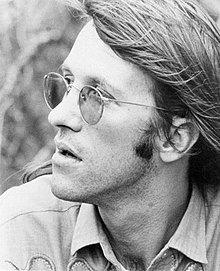 Sahm in 1974 | |
| Groundwork information | |
| Birth proper name | Douglas Wayne Sahm |
| As well known as | Petty Doug Doug Saldaña Samm Dogg Wayne Douglas |
| Born | (1941-11-06)November six, 1941 San Antonio, Texas, U.South. |
| Died | November eighteen, 1999(1999-11-xviii) (aged 58) Taos, New Mexico, U.S. |
| Genres | Tejano/Tex-Mex, Country, Rock, Dejection, Rhythm and blues |
| Occupation(s) | Musician singer-songwriter bandleader |
| Instruments | Guitar, steel guitar, fiddle, mandolin, bajo sexto, dobro, drums, piano |
| Years active | 1946–1999 |
| Labels | (Various)
|
| Associated acts | (Various)
|
Douglas Wayne Sahm (November 6, 1941 – November 18, 1999) was an American musician, singer-songwriter and multi-instrumentalist born in San Antonio, Texas. Sahm is regarded as one of the main figures of Tex-Mex music, and as an of import performer of Texan Music. He gained fame along with his ring, the Sir Douglas Quintet, with a top-xx striking in the U.s.a. and the United kingdom of great britain and northern ireland with "She's About a Mover" (1965). Sahm was influenced by the San Antonio music scene that included conjunto and blues, and subsequently past the hippie scene of San Francisco. With his blend of music, he plant success performing in Austin, Texas, as the hippie counterculture soared in the 1970s.
Sahm began singing at age 5 and learned to play the steel guitar at age vi. He was considered a child prodigy on the instrument. By the historic period of eight, he had appeared on the Louisiana Hayride. He made his recording debut as "Little Doug" in 1955, and was influenced by rock and gyre during his teenage years. Sahm had local striking records, while he played clubs equally a musician for other bands. In 1965, Huey P. Meaux produced Sahm and the Sir Douglas Quintet'southward "She's About a Mover". The aforementioned year, Sahm moved to California. In 1971, he returned to San Antonio, and shortly after he moved to Austin. Atlantic Records signed Sahm and released his debut solo album Doug Sahm and Ring in 1973.
After a continuing pass up in record sales, Sahm kept performing in clubs in Austin, and moved through unlike tape labels. Meanwhile, he enjoyed success in Sweden and in Canada. In 1989, Sahm formed the supergroup the Texas Tornados with beau Tex-Mex musicians Augie Meyers, Freddy Fender and Flaco Jiménez. The Texas Tornados toured successfully, and one of their releases earned a Grammy Honour. In 1999, Sahm died during a vacation trip. A posthumous album, The Return of Wayne Douglas, was released in 2000. Sahm received multiple honors in the land of Texas, including hall of fame inductions and memorials in public places.
Early on life and showtime in music [edit]
Doug Sahm was born in San Antonio, Texas, on November 6, 1941, to Victor A. Sahm, Sr. and Viva Lee (née Goodman).[one] The Sahm family had migrated to the U.s. from Federal republic of germany early in the 20th century, and settled initially in Galveston, Texas. Sahm's grandparents, Alfred and Alga, owned a subcontract nigh Cibolo, Texas. Alfred Sahm was a musician who played with the polka band The Sahm Boys. During the Groovy Depression, Sahm'south parents moved to San Antonio, where Victor worked at Kelly Field Air Force base of operations.[2]
Sahm began singing at age 5, and took upward the steel guitar at age six. The same year, he appeared on San Antonio's radio station KMAC and performed the Sons of the Pioneers' "Teardrops in My Middle".[iii] He was regarded equally a kid prodigy on the steel guitar.[4] [5] [6] His mother took him to a local music school, but his teacher turned him down shortly after. His teacher explained he could non teach Sahm to read music, and the boy could already play by ear. Sahm often appeared at a local social club, The Befouled, which his uncle co-owned with Charlie Walker.[vii] By the time he was eight, he could play the dabble and mandolin, and he began to appear on the Louisiana Hayride equally "Niggling Doug".[1] He besides performed shows with Hank Williams, Faron Young and Hank Thompson. At age thirteen, he was offered a spot on the Grand Ole Opry that his mother declined, wanting him to finish school.[ane] In 1953, Sahm met Augie Meyers while he purchased baseball cards at Meyer's mother's grocery store,[8] and the two became friends. Meyers and Sahm discussed forming a ring, only nothing came of information technology as both played with unlike groups. Meyers mastered the accordion, pianoforte and rhythm guitar.[9] Sahm grew up on the East side of San Antonio, a predominantly blackness neighborhood. He listened from his home to the live performances of T-Os Walker and other blues artists who appeared at a nearby blues bar, the Eastwood State Club.[7] Sahm'southward neighbor, Homer Callahan, introduced him to the records of Howlin' Wolf, Lonesome Sundown, Fats Domino, Jimmy Reed, and Atlantic and Excello Records.[10]

High school portrait of Sahm, circa 1958
In 1955, producer Charlie Fitch released Sahm's debut unmarried on Sarg Records.[11] Cataloged with the number 113-45 on the label's releases, the paring of "A Real American Joe" with "Rollin' Rollin'" was credited to Footling Doug.[12] The same year, Sahm formed his commencement ring, The Kings. A year later, 1 of his concerts in school was interrupted by the principal afterward Sahm started imitating Elvis Presley'south gyrations. The students left the auditorium and headed to Sahm's firm to continue listening to the band.[7] Every bit he continued performing land music, fiddler J. R. Chatwell, who played with bandleader Adolph Hofner, mentored him. The music of Lefty Frizzell, Howlin' Wolf, Lonesome Sundown, Elvis Presley, Little Richard, T-Bone Walker, Floyd Tillman, and San Antonio musicians Johnny Owen and Ricky Aguirre influenced him during his teenage years.[13] [fourteen] [7]
Sahm enjoyed success performing in San Antonio nightclubs,[15] as he played a blend of music that consisted of rhythm and dejection with the addition of the W Side tenor saxophone thespian Eracleo "Rocky" Morales.[xvi] The "West Side Sound", feature of San Antonio, consisted of a alloy of genres: country music, conjunto, rhythm and dejection, polka and rock and roll.[17] [18] [19] Meanwhile, Sahm performed on guitar six nights a week with Jimmy Johnson'southward ring.[7] Saxophonist Spot Barnett invited him to play at the Ebony rhythm and blues order.[8]
Sahm fronted three bands: The Pharaohs, The Dell-Kings and The Markays. He released the song "Crazy Daisy" (1959), and he had a local hit with "Why Why Why" (1960) on Renner Records.[twenty] [21] Sahm graduated from high school the aforementioned year. He had another local hit with "Crazy, Crazy Feeling" (1961);[vii] "Just A Moment" (1961) and "Lucky Me" (1963) followed.[22] By 1964, Sahm was dropped past the Renner characterization and he tried to convince Huey P. Meaux to sign him. Meaux, the owner of SugarHill Recording Studios, was enjoying success with Dale and Grace and Barbara Lynn, and turned Sahm down.[6]
The Sir Douglas Quintet [edit]

The Sir Douglas Quintet in 1965 (Sahm to the right)
Meaux produced songs that appeared on the music charts in the 1960s, merely because of Beatlemania and the British Invasion, his records stopped selling well. Adamant to observe the reason for the commercial success of The Beatles sound, Meaux said he purchased several of their records and rented three rooms at the Wayfarer Hotel in San Antonio. Co-ordinate to his business relationship, he drank a case of Thunderbird wine in the procedure.[23] Meaux felt the Beatles' songs shared a mutual ground with traditional two-step Cajun music.[24] He chosen Sahm and asked him to write songs based on that fashion, and to let his hair grow.[23] Sahm and Meyers appeared with The Dave Clark Five in San Antonio, where they were featured on the program, with their corresponding bands, every bit the opening acts. Sahm appeared with the Markays, and Meyers the Goldens.[25] Meyers attributed Meaux'south involvement in recording Sahm and himself to their performance at the concert.[26]
Sahm put together a band with Meyers (keyboard), Frank Morin (saxophone), Harvey Kagan (bass) and Johnny Perez (drums).[22] Based on The Beatles' "She's a Woman", Sahm wrote a song that integrated their style with the sounds characteristic of tejano music.[27] Sahm chosen his new composition "She'southward A Trunk Mover". Meaux purchased the song from him for $25 (equivalent to $200 in 2021), but he felt the title would not help it become airplay. Instead, he renamed it "She'due south About a Mover".[24] The song was released on Tribe Records in 1965 and credited to the Sir Douglas Quintet—an "English-sounding" name created by Meaux to capitalize on the success of the British Invasion.[28] [six] The outset publicity pictures of the ring were taken in silhouette to conceal the appearances of Frank Morin and Johnny Perez, the Latino members of the band.[27] "She's About a Mover" peaked at number 13 on the Billboard Hot 100,[28] and reached number 15 on the Britain Singles Chart.[29] The success of the song propelled the Sir Douglas Quintet to bout, and to become an opener for The Beatles and The Beach Boys.[30] They appeared on Hullabaloo, and host Trini Lopez revealed the real origin of the ring. The quintet toured the The states with James Dark-brown, and Europe with The Beach Boys and the Rolling Stones.[31]
Subsequently meeting Sahm in New York City in 1965, Bob Dylan said in an interview he felt the Sir Douglas Quintet would be a commercial success on radio. Dylan and Sahm met again in London while the Sir Douglas Quintet toured England.[32] During a finish in Corpus Christi, Texas, in December 1965, Sahm and Morin were arrested for possession of marijuana[33] upon their arrival at the Corpus Christi International Drome. The bond for the musicians' release was set at $1,500 (equivalent to $12,900 in 2021). Sahm got the coin from his family unit in San Antonio.[34] The ring pleaded guilty to the accuse of "receiving and concealing marijuana without paying the required transfer tax". Judge Reynaldo Guerra Garza sentenced them to probation with supervision for five years in March 1966.[35] Meyers was forbidden from leaving Texas for the duration of his probation.[36] A serial of appearances with the band in pocket-sized towns around the state made Sahm unhappy. Later his parole officeholder allowed him to leave Texas the same yr, he decided to move to California with his wife and children.[37]
Move to California and return to Texas [edit]
Sahm moved to Salinas, California, and became involved in San Francisco'south burgeoning hippie scene.[8] He gathered once more with the musicians of the Sir Douglas Quintet, excluding Meyers, whose parole officer did not allow to leave Texas.[38] Sahm became acquainted with the music acts playing in the Haight-Ashbury district, and performed at venues including The Fillmore and the Avalon Ballroom.[viii] Through audio engineer Dan Healy, Sahm met and befriended Jerry Garcia. The Sir Douglas Quintet opened for the Grateful Dead in Oakland, California,[39] and in Oct 1966 performed with Large Brother and the Holding Company featuring Janis Joplin.[forty] Helped by lawyer Brian Rohan, who represented the Grateful Dead, Sahm was signed to Mercury Records and its subsidiary labels.[40] In December 1968, Sahm appeared with his son, Shawn, on the encompass of Rolling Stone magazine. His arrival in San Francisco with the other Texan musicians was covered in the feature "Tribute to the Lone Star State: Dispossessed Men and Mothers of Texas".[41] During the photo shooting, Sahm took his son and sat him on his lap to emulate a childhood photograph that had been taken of him with Hank Williams.[42] In 1969, Meyers joined Sahm in San Francisco for the recording of Mendocino.[8] The anthology'south title rail reached number 27 on the Billboard Hot 100.[43]
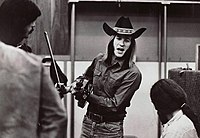
Sahm recording for Atlantic Records in 1972
Sahm left California in 1971 and returned to San Antonio.[44] He released an anthology entitled The Return of Doug Saldaña with the Sir Douglas Quintet; Chicano musicians in San Antonio had given him the nickname "Saldaña".[27] A embrace of "Wasted Days and Wasted Nights" on the album helped to reignite the career of its original singer, Freddy Fender.[45] The aforementioned year, Rolling Stone featured Sahm on its cover once again and ran his interview with Chet Flippo.[vii]
Sahm moved to Austin that year equally the local hippie scene grew. He appeared at the Armadillo World Headquarters and the Soap Creek Saloon in Austin.[8] In 1972, he disbanded the Sir Douglas Quintet.[44] The same yr, he made a cameo appearance in the movie Cisco Motorway, starring Kris Kristofferson.[46] Sahm performed on the motion-picture show'south song "Michoacan", but radio stations refused to play it considering of its references to marijuana.[45]
Jerry Wexler signed Sahm to the newly created progressive country division of Atlantic Records in 1972. In October 1972, he recorded Doug Sahm and Band in New York City with guest appearances by Bob Dylan, Dr. John, David "Fathead" Newman, Flaco Jimenez, David Bromberg and Kenny Kosek.[47] The release garnered mixed reviews and sold poorly,[48] reaching number 125 on Billboard 'south Top LPs & Tapes.[49] In February 1973, he joined Willie Nelson during the recording of Shotgun Willie in New York City and featured on the album with his own musicians.[50] Sahm also joined the Grateful Expressionless's recording sessions.[51] As he continued to enjoy success in Austin's venues, Sahm used textile left over from his October 1972 sessions with Atlantic Records for his 1973 release Texas Tornado.[eight] Atlantic folded its country music division in 1973.[52] The following year Warner Records released his next album,[53] Groover's Paradise, featuring Doug Clifford and Stu Cook, former musicians in Creedence Clearwater Revival.[eight] Texas Monthly wrote the anthology captured Austin's "insouciant essence" as a "carefree hippie mecca".[54] Equally he toured to promote the album, Sahm made his debut performance at Carnegie Hall.[55]
Sahm's record sales continued to reject,[8] and he rarely performed concerts exterior the Austin club scene.[56] In 1975, he produced one-time 13th Flooring Elevators front end man Roky Erickson post-obit Erickson's release from Rusk State Infirmary.[57] In 1976, Sahm collaborated again with Meaux on the release of Texas Stone For State Rollers. As well vocals, Sahm played pb guitar, fiddle and pianoforte. Meyers also joined the project and performed on the piano and organ.[58] The same twelvemonth, Sahm appeared on the fifth episode of the first season of Austin Urban center Limits.[59] In 1979, he fabricated a cameo appearance in the moving-picture show More American Graffiti.[threescore]
The 1980s, the Texas Tornados and the 1990s [edit]
Sahm released 2 albums on Takoma Records: the solo record Hell of a Spell (1980), followed by a collaboration with the Sir Douglas Quintet on Border Wave (1981).[iii] Sahm reformed the band later it had gained momentum from the success of new moving ridge music, and the utilise of organs featured by Elvis Costello and The Attractions.[45] Sahm and the Sir Douglas Quintet and so signed a record deal with the Swedish label Sonet Records in 1983.[8] Their release Midnight Sunday, became a success: It sold 50,000 copies in Sweden, some other l,000 copies in the rest of Scandinavia,[54] and reached number 27 on the Topplistan.[61] Its single "Come across Me in Stockholm" became a hit.[62] Midnight Sun, and their second release with the label, Rio Medina, were recorded in the United States. Sahm and the Sir Douglas Quintet toured Scandinavia and also played in the netherlands.[54] By 1985, Sahm had moved to Canada after he visited friends in Vancouver, merely he returned to Austin every yr to take part in the South by Southwest festival.[63] He formed the band The Texas Mavericks in Austin in 1987 with Alvin Crow (fiddle), Speedy Sparks (bass), John Reed (guitar), and Ernie Durawa (drums).[64] Sahm sang under the pseudonym "Samm Dogg", and he and the ring performed wearing wrestling masks.[65] Meanwhile, in Canada, along with Amos Garrett and Gene Taylor, he recorded The Return of the Formerly Brothers. The release earned them the Juno Award for Best Roots and Traditional Album in 1989.[66] In September 1989, half dozen years later his last record release in the The states, Sahm partnered with club owner and blues impresario Clifford Antone for the release of Juke Box Music on Antone'south Record Label.[67] Past the end of the decade, Sahm often performed at the Austin night guild Antone's.[68] He used the guild's firm ring on the recording.[69]
In 1989, Sahm formed the Texas Tornados with Meyers (organ, vocals), Fender (guitar, vocals) and Jimenez (squeeze box, vocals). The group's songs featured the Tex-Mex audio—a mixture of rock, land music, conjunto and dejection.[70] [71] Warner Brothers signed the band to a recording contract, and in 1991 they released Texas Tornados.[72] The album charted at number five on Billboard's Acme Country Albums. Meanwhile, it earned the Grammy Accolade for All-time Mexican/Mexican-American Album. A version of the anthology sung in Spanish entitled Los Texas Tornados was released at the same time.[73] The ring appeared in Europe and Japan.[74] Along with Willie Nelson, the Texas Tornados were featured at the starting time inauguration of Beak Clinton.[45] The band performed at the America'southward Reunion on the Mall event, as well as in other venues around Washington, D.C. during their stay.[75]
In 1994, Sahm and Meyers formed a new version of the Sir Douglas Quintet. It included Sahm's sons Shawn on guitar and Shandon on drums.[76] The band released the album Day Dreaming at Midnight.[77] Sahm then formed The Last Real Texas Blues Band with the musicians he performed with at Antone'south. In 1995, the group, equanimous of Rocky Morales (tenor saxophone), Sauce Gonzalez (Hammond organ), Meyers (piano), Denny Freeman (guitar) and Derek O'Brian (guitar), recorded a studio album of their alive performances. Antone'southward Tape Label released it as The Final Real Texas Blues Band Featuring Doug Sahm. The album included standards by T-Os Walker and Lowell Fulson.[68] It was nominated for the Grammy Accolade for All-time Traditional Blues Anthology.[78]
Sahm and the Texas Tornados' song "A Trivial Bit is Better Than Nada" was featured in the 1996 film Tin Loving cup.[45] In 1998, Sahm collaborated with The Gourds for the release S.D.Q. 98'.[8] The same year, he joined the Latino supergroup Los Super Seven.[79] By 1999, impressed by Dallas singer Ed Burleson, Sahm assembled a band that consisted of Beak Kirchen (guitar), Tommy Detamore and Clay Baker (steel guitars) and Alvin Crow (fiddle). Sahm booked the Cherry Ridge Studios in Floresville, Texas, and he assisted with the recording of Burleson's debut anthology My Perfect World. The album was the first release on Sahm's ain label, Tornado Records. Using the same band, Sahm extended the booking at Cherry Ridge Studios for a series of recording sessions during July and August 1999.[eighty]
Personal life [edit]
Sahm met Violet Morris at a Christmas party in 1961. At the fourth dimension, Morris worked every bit an executive secretary at a Montgomery Ward department store. The couple married in 1963. Morris had three children from a previous marriage, and in 1964, she gave birth to Dawn Sahm.[81] Equally he was responsible for his wife and four children, Sahm was classified i-Y on the Selective Service System.[82] His first son, Shawn, was built-in in 1965,[83] and Shandon in 1969.[84]
In 1973, during a visit to the Mexican eating place La Rosa in San Antonio, Sahm was apprehended by police officers who searched him, his machine, and his companions for drugs. As they searched the motorcar, his dabble was cleaved.[85] After being handcuffed, Sahm was browbeaten past the police force officers equally he continued to protestation and move. He was arrested for public intoxication.[86] The case was dismissed at his trial in June 1973, and Sahm unsuccessfully tried to sue the urban center.[87] Violet had already been unhappy with the union because of Sahm'due south numerous affairs,[88] and after his abort, they divorced.[89]
Sahm was a defended follower of baseball. He followed several teams and visited their training camps through the years. He oft refused to attend rehearsals to watch games, and on one occasion, he rejected a tour to exist able to watch the Globe Series.[8] [ninety]
Death [edit]
By the stop of 1999, Sahm decided to have a vacation trip to New United mexican states. He planned to visit a friend in Taos, New Mexico, then continue to a cabin in the Sangre de Cristo Range and stop the trip with a visit to Dan Healy in San Francisco.[91] Sahm left for New Mexico afterwards a brief visit with his son Shawn in Boerne, Texas. During the trip, Sahm called his son to inform him he had been feeling sick and that he oftentimes had to pull over to vomit. Sahm checked into the Kachina Lodge Hotel in Taos, New Mexico. His son connected calling him over the adjacent few days. Sahm's girlfriend, Debora Hanson, and Shawn offered to wing to New Mexico and bulldoze him dorsum to Texas. Sahm initially refused, but he agreed to drive himself to Albuquerque, New Mexico, to meet Hanson there for the bulldoze back to Texas. As his condition worsened, he asked a clerk about local doctors. They advised him to visit the local emergency room, but he did not practice so.[92] On November xviii, 1999, Sahm was found dead in his hotel room. Local government determined it to be a expiry by natural causes, but an dissection was ordered.[93] [94] The results of the autopsy adamant that Sahm died of arteriosclerotic cardiovascular illness, described as a centre set on.[95] The Austin Music Network aired a three-hour tribute to Sahm, while KUT dedicated an episode of one of its shows to his music. A memorial concert was appear to take place at Antone's in December 1999.[96]
On November 23, 1999, Sahm's funeral took place at the Sunset Memorial Home in San Antonio.[96] Loudspeakers were placed outside of the funeral home for the service to be heard by the estimated one m mourners in attendance. According to the Austin American Statesman, the crowd consisted of people "across all lines of historic period, race and social continuing".[97] The viewing lasted an hr-and-a-half, as the mourners passed Sahm's casket and left keepsakes. Freddy Fender chose non to attend the funeral to avoid distracting the crowds with his presence.[97] Bob Dylan, Bruce Springsteen,[96] and then-Texas governor George W. Bush and Willie Nelson reached out to the family to limited their condolences.[98] A planned tribute by a local radio station had to be called off, as the viewing took longer than expected, and the station's programming moved to the broadcast of the weather condition report.[99] Sahm was buried in a individual ceremony at Sunset Memorial Park in San Antonio, next to his female parent and father.[99] [i]
In July 2000, the songs recorded at the Crimson Ridge Studios sessions the previous year were released on the posthumous album The Render of Wayne Douglas.[lxxx]
Legacy [edit]
His long hair and sideburns, his use of sunglasses and his preference for western attire including cowboy hats and boots characterized Sahm's expect.[100] [68] [25] [seven] His music style encompassed country music, blues, rock and roll, Cajun music, rhythm and dejection, doo-wop and tejano music. Psychedelic music during his time in San Francisco, jazz and the compositions of Bob Dylan later influenced him.[8] [101] [102] [103] Sahm'southward presence was described equally "impulsive, restless and energetic" by Texas Monthly,[69] while his way of talking was characterized by a "rapid-fire" manner and the employ of hippie jargon.[69] [104] A multi-instrumentalist, Sahm mastered the steel guitar, mandolin, fiddle, electric guitar, electric bass, dobro, bajo sexto, drums and pianoforte.[95] [105] [106] [107]
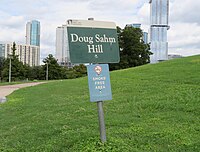
Sign marking "Doug Sahm Hill" with The Contained building seen in the groundwork
Rolling Stone wrote that "Lone Star music, at its best, in every form, was organized religion to Sahm."[108] The magazine ranked him at number 60 on their 100 Greatest Country Artists of All Fourth dimension in 2017.[109] To Billboard, Sahm was a "central figure in the world of Tex-Mex".[95] New Musical Express considered him "an unpaid PR human for the land of Texas and all things Texan".[110] The New York Times saw Sahm every bit "a patriarch of Texas stone and country music".[111] Lone Star Music Magazine called him "the Godfather of San Antonio rock 'northward' roll".[112] The Austin Chronicle commented: "If Texas had such designation, Douglas Wayne Sahm would be the Country Musician of Texas."[113] AllMusic accounted the vocalist "a highly knowledgeable and superbly competent performer of Texan musical styles".[114]
Sahm was featured in the 1974 mural "Austintatious" at the Elevate portion of Guadalupe street in Austin.[115] He was inducted into the Austin Music Awards Hall of Fame with the 1982–1983 class.[116] In 2002, the Americana Music Association gave him the President's Honor.[117] In 2008, he was an inaugural inductee to the Austin Music Memorial.[118] On April 10, 2008, Austin Urban center Council approved the motion to rename the spiral loma in Butler Metro Park to Doug Sahm Hill, in recognition of his "nifty talents in the music industry".[119] The 35-foot (eleven-metre) colina is the highest betoken in the park, with a 360° view of Austin's skyline.[120] In November 2009, artist David Blancas completed La Música de San Anto for the San Anto Cultural Arts Customs Mural Plan. Located on the westward side of San Antonio, the 141-past-17-human foot (43-by-5.2-metre) mural features San Antonio musicians including Sahm.[121] Blancas restored the mural in 2020.[122] Federico Archuleta also painted two murals in Austin depicting Sahm.[123]
In 2009, a tribute album recorded by San Antonio musicians, Keep Your Soul: A Tribute to Doug Sahm, was released.[108] On Sahm's altogether, November 6, 2010, a plaque was added to the height of Doug Sahm Hill. The plaque features a caricature of Sahm by Kerry Awn and a short biography written by Austin Chronicle's music columnist Margaret Moser.[124] As well in 2010, Shawn Sahm and the Texas Tornados released the album ¡Está bueno!. Sahm's son and the surviving members of the group toured promoting the album.[125] In 2015, Sahm was inducted to the S Texas Music Walk of Fame.[118] The same year, music writer Joe Nick Patoski premiered his documentary on Sahm Sir Doug and the Genuine Texas Cosmic Groove at the S by Southwest festival. Patoski started a petition to induct Sahm into the Stone and Roll Hall of Fame.[126] Music producer Kevin Kosub established a small-scale museum featuring memorabilia from Sahm'due south career.[127]
Discography [edit]
References [edit]
- ^ a b c d Jasinski, Laurie 2012, p. 1382.
- ^ Reid, Jan & Sahm, Shawn 2010, p. iii.
- ^ a b Helander, Brock 2001, p. 632.
- ^ Powell, Austin, Freeman, Doug & Johnston, Daniel 2011, p. 85.
- ^ Reid, January 2004, p. 44.
- ^ a b c Larkin, Colin 2002, p. 382.
- ^ a b c d e f g h Flippo, Chet 1971, pp. 26, 27.
- ^ a b c d eastward f thousand h i j thou l 1000 Magnet staff 2002.
- ^ Reid, Jan & Sahm, Shawn 2010, p. 10.
- ^ Antone'southward Tape Label staff 1995.
- ^ Bradley, Andy & Wood, Roger 2010, p. 88.
- ^ Billboard staff 1955, p. 48.
- ^ Reid, Jan & Sahm, Shawn 2010, p. 7.
- ^ Wolff, Kurt 2000, p. 421.
- ^ Reid, Jan & Sahm, Shawn 2010, p. 20.
- ^ Govenar, Alan 1988, p. 203.
- ^ Guerra, Claudia 2018, p. 503.
- ^ Olsen, Allen 2005.
- ^ Patoski, Joe Nick 2020.
- ^ Gart, Gallen 2002, p. 104.
- ^ Reid, Jan & Sahm, Shawn 2010, p. 22.
- ^ a b Larkin, Colin 2011, p. 12.
- ^ a b Leigh, Spencer 2016, p. 155.
- ^ a b Meaux, Francois 2018, p. 92.
- ^ a b Busby, Marking 2004, p. 340.
- ^ Reid, January & Sahm, Shawn 2010, p. 27.
- ^ a b c Avant-Mier, Roberto 2010, p. 100.
- ^ a b Leszczak, Bob 2014, p. 194.
- ^ Rees, Dafydd & Crampton, Luke 1991, p. 26.
- ^ Buckley, Peter 2003, p. 942.
- ^ Curtis, Gregory 1974, p. 47.
- ^ Reid, Jan & Sahm, Shawn 2010, p. 34, 35.
- ^ Walraven, Beak 1965, p. 1.
- ^ Walraven, Bill 1965, p. 12.
- ^ Corpus Christi Caller-Times staff 1966, p. B1.
- ^ Reid, Jan & Sahm, Shawn 2010, p. 37.
- ^ Reid, Jan & Sahm, Shawn 2010, p. 38.
- ^ Reid, Jan & Sahm, Shawn 2010, p. 41.
- ^ Reid, January & Sahm, Shawn 2010, p. 43.
- ^ a b Reid, Jan & Sahm, Shawn 2010, p. 44.
- ^ Sepulvado, Larry & Burks, John 1968.
- ^ Reid, Jan & Sahm, Shawn 2010, p. 12.
- ^ Whitburn, Joel 1990, p. 226.
- ^ a b Jasinski, Laurie 2012, p. 1383.
- ^ a b c d e Riemenschneider, Chris ii 1999, p. 32.
- ^ Kubernik, Harvey 2006, p. 89.
- ^ Billboard staff 1973, p. 18.
- ^ Reid, Jan & Sahm, Shawn 2010, p. 107.
- ^ Lazell, Barry 1989, p. 462.
- ^ Reid, Jan 2004, p. 224.
- ^ Sansone, Glen 1999, p. five.
- ^ Country Music Magazine staff 1994, p. 53.
- ^ DiMartino, Dave 1994, p. 217.
- ^ a b c Denberg, Jody 1984, p. 228.
- ^ Schulian, John 1974, p. C1.
- ^ Patoski, Joe Nick 1977, p. 118.
- ^ Stegall, Tim 2019.
- ^ Bradley, Andy & Forest, Roger 2010, p. 201.
- ^ Laird, Tracey 2014, p. 40.
- ^ Gray, Michael 2006, p. 596.
- ^ Sverigetopplistan staff 2020.
- ^ Gale Research staff 1989, p. 260.
- ^ Reid, Jan & Sahm, Shawn 2010, pp. 161–163.
- ^ Reid, Jan & Sahm, Shawn 2010, p. 156.
- ^ Swenson, John 1987.
- ^ Mackie, John 1989, p. B6.
- ^ Denberg, Jody 1989, p. 128.
- ^ a b c McLeese, Don 1995, p. B6.
- ^ a b c Denberg, Jody 1989, p. 130.
- ^ Marks, Craig 1993, p. 18.
- ^ Hartman, Gary 2008, p. 208.
- ^ Jasinski, Laurie 2012, p. 1538.
- ^ Jasinski, Laurie 2012, p. 1539.
- ^ Ellingham, Marker 1999, p. 505.
- ^ Austin-American Statesman staff 1993, p. A13.
- ^ Huey, Steve 2021.
- ^ Chadbourne, Eugene 2021.
- ^ Grammy staff 2021.
- ^ Harrington, Richard 1999.
- ^ a b Renshaw, Jerry 2000.
- ^ Reid, Jan & Sahm, Shawn 2010, p. 23.
- ^ Reid, Jan & Sahm, Shawn 2010, p. 24.
- ^ Reid, January & Sahm, Shawn 2010, p. 36.
- ^ Reid, Jan & Sahm, Shawn 2010, p. 47.
- ^ Reid, Jan & Sahm, Shawn 2010, p. 107-108.
- ^ Reid, Jan & Sahm, Shawn 2010, p. 109.
- ^ Reid, Jan & Sahm, Shawn 2010, p. 110.
- ^ Davis, John 2010, p. G6.
- ^ Reid, Jan & Sahm, Shawn 2010, p. 111.
- ^ Reid, January & Sahm, Shawn 2010, p. Prologue.
- ^ Reid, Jan & Sahm, Shawn 2010, p. 177.
- ^ Reid, Jan & Sahm, Shawn 2010, p. 179.
- ^ Cromelin, Richard 1999.
- ^ Chicago Tribune staff 1999.
- ^ a b c Burr, Ramiro 1999, p. 6.
- ^ a b c Riemenschneider, Chris 1999, p. B4.
- ^ a b Corcoran, Michael 1999, p. 1.
- ^ Corcoran, Michael 1999, p. A1.
- ^ a b Corcoran, Michael 2 1999, p. A17.
- ^ Powell, Austin, Freeman, Doug & Johnston, Daniel 2011, p. 131.
- ^ Curtis, Gregory 1974, p. 46.
- ^ Walker, Jesse 2004, p. 144.
- ^ Corcoran, Michael three 1999, p. xxx.
- ^ Hilburn, Robert 1974, p. 58.
- ^ Reid, Jan & Sahm, Shawn 2010, p. 16.
- ^ Joynson, Vernon 1984, p. 93.
- ^ Patoski, Joe Nick 2000.
- ^ a b Fricke, David 2009.
- ^ Rolling Rock staff 2017.
- ^ NME staff 1999.
- ^ Pareles, Jon 1999, p. 28A.
- ^ Hisaw, Eric 2010.
- ^ Moser, Margaret 1999.
- ^ AllMusic staff 2010.
- ^ Cost, Asher 2014.
- ^ Austin Chronicle staff 2021.
- ^ Waddel, Ray 2002, p. 27.
- ^ a b Head, James & Jasinski, Laurie 2021.
- ^ Austin City Quango 2008.
- ^ Llewellin, Charlie 2019, p. 99.
- ^ San Anto staff 2009.
- ^ Martin, Deborah 2020.
- ^ Faires, Robert 2010, p. 26, 28.
- ^ Dunlop, Machelle 2011.
- ^ Lopetegui, Enrique 2011.
- ^ Whittaker, Richard 2015.
- ^ Buffkin, Travis 2016.
- Sources
- AllMusic staff (2010). "Doug Sahm". AllMusic . Retrieved February 15, 2021.
- Antone's Record Label staff (1995). "The Last Real Texas Blues Band" (CD). Antone's Tape Characterization. Emmet 0036.
- Austin-American Statesman staff (Jan 21, 1993). "Hoopla!". Austin-American Statesman. Vol. 122, no. 180. Retrieved July 11, 2021 – via Newspapers.com.

- Austin City Council (April ten, 2008). "Regular Meeting of the Austin City Council April 10, 2008". City of Austin. Retrieved February 14, 2021.
- Austin Chronicle staff (2021). "Austin Music Awards". The Austin Chronicle . Retrieved February 25, 2021.
- Avant-Mier, Roberto (2010). Rock the Nation: Latin/o Identities and the Latin Stone Diaspora. Bloomsbury Publishing. ISBN978-i-441-16797-two.
- Billboard staff (July 9, 1955). "Other Records Released this Week". Billboard . Retrieved Jan 25, 2021 – via Google Books.
- Billboard staff (January thirteen, 1973). "The Doug Sahm Sessions". Billboard. Nielsen Concern Media, Inc. 85 (2). ISSN 0006-2510. Retrieved Feb two, 2021.
- Bradley, Andy; Wood, Roger (2010). Business firm of Hits: The Story of Houston'south Gilded Star/SugarHill Recording Studios. University of Texas Printing. ISBN978-0-292-78324-9.
- Buckley, Peter (2003). The Rough Guide to Stone. Rough Guides. ISBN978-i-843-53105-0.
- Buffkin, Travis (June 9, 2016). "Doug Sahm Museum Creator Kevin Kosub: Grade-A Bullshitter and Old School Man of SA". San Antonio Current. Archived from the original on October 1, 2020. Retrieved March ane, 2021.
- Burr, Ramiro (December iv, 1999). "Doug Sahm, Tex-Mex Pioneer, Dies at 58". Billboard. 111 (49). Retrieved February 12, 2021 – via Google Books.
- Busby, Mark (2004). The Southwest. Greenwood Publishing Group. ISBN978-0-313-33266-1.
- Chadbourne, Eugene (2021). "The Sir Douglas Quintet - Day Dreaming at Midnight". AllMusic . Retrieved February iv, 2021.
- Chicago Tribune staff (November 23, 1999). "Musician Doug Sahm, 58, leader of Sir Douglas Quintet". Chicago Tribune . Retrieved February eleven, 2021.
- Corpus Christi Caller-Times staff (March 23, 1966). "Musicians Become Suspended Term". Corpus Christi Caller-Times. Vol. 55, no. 224. Retrieved Feb i, 2021 – via Newspapers.com.
- Country Music Magazine staff (1994). The Comprehensive Land Music Encyclopedia. Times Books. ISBN978-0-812-92247-9.
- Corcoran, Michael (November ane, 1999). "Fittingly, a happy notation on a sad mean solar day". Austin American-Statesman. Vol. 121, no. 129. Retrieved February 12, 2021 – via Newspapers.com.
- Corcoran, Michael 2 (November 1, 1999). "Doug Sahm'southward friends, fans celebrate a Texas original". Austin American-Statesman. Vol. 121, no. 129. Retrieved February 12, 2021 – via Newspapers.com.
- Corcoran, Michael iii (November 25, 1999). "Last of the Great Hippies". Austin American-Statesman. Vol. 129, no. 122. Retrieved Feb 12, 2021 – via Newspapers.com.
- Cromelin, Richard (November 20, 1999). "Doug Sahm; Musician Blended Rock, Country and Blues in Colorful Career". Los Angeles Times . Retrieved February 11, 2021.
- Curtis, Gregory (Apr 1974). "He'south Most a Mover". Texas Monthly. 4 (ii). Retrieved February 12, 2021 – via Google Books.
- Davis, John (February 28, 2010). "Musician:His life similar Texas Tornado". Austin American-Statesman. Vol. 139, no. 218. Retrieved February 12, 2021 – via Newspapers.com.
- Denberg, Jody (November 1984). "Lawrence Welk Meets The Doors". Texas Monthly. 12 (11). Retrieved February iii, 2021 – via Google Books.
- Denberg, Jody (April 1989). "Beyond the Blues". Texas Monthly. 17 (4). Retrieved Feb 12, 2021 – via Google Books.
- DiMartino, Dave (1994). Singer-songwriters: Popular Music'southward Performer-composers from A to Zevon. Billboard Books. ISBN978-0-823-07629-i.
- Dunlop, Machelle (February 2011). "Sir Doug Gets His Due". Lone Star Music Magazine . Retrieved Feb 14, 2021.
- Ellingham, Marking (1999). The Crude Guide to World Music. Rough Guides. ISBN978-1-858-28636-5.
- Faires, Robert (Nov xiii, 2010). "'Til Death Do U.s.a. Autonomously" (PDF). Austin Chronicle. 40 (11). Retrieved February sixteen, 2021.
- Flippo, Chet (July eight, 1971). "Sir Douglas of the Quintet Is Back (in Texas)". Rolling Stone (86). Retrieved February 14, 2021.
- Fricke, David (March 27, 2009). "Fricke'due south Picks: The Male monarch of Texas, Doug Sahm". Rolling Stone . Retrieved February fifteen, 2021.
- Gale Research staff (1989). Contemporary Musicians. Gale Enquiry. ISBN978-0-810-35403-6.
- Gart, Gallen (2002). First Pressings: The History of Rhythm and Blues (1959). Vol. 9. Large Nickle Pubns. ISBN978-0-936-43309-seven.
- Govenar, Alan (1988). Meeting the Blues. Taylor Publishing Company. ISBN978-0-878-33623-four.
- Grammy staff (2021). "38th Annual Grammy Awards (1995)". Recording Academy . Retrieved February 12, 2021.
- Gray, Michael (2006). The Bob Dylan Encyclopedia. Bloomsbury Academic. ISBN978-0-826-46933-5.
- Guerra, Claudia (2018). 300 Years of San Antonio and Bexar County. Trinity University Press. ISBN978-1-595-34850-0.
- Hartman, Gary (2008). The History of Texas Music. Texas A&M University Printing. ISBN978-i-603-44001-1.
- Harrington, Richard (February 3, 1999). "Magnificent Seven: Ole! to the Music of Mexico". Washington Post . Retrieved February 17, 2021.
- Hilburn, Robert (June 15, 1974). "A Texan Tries it every bit a Lone Star". Los Angeles Times. Vol. 93. Retrieved Feb 22, 2021 – via Newspapers.com.
- Hisaw, Eric (August one, 2010). "Mr. Tape Man: Doug Sahm, Sir Douglas Quintet and the Texas Tornados". Lone Star Music Magazine . Retrieved February xv, 2021.
- Head, James; Jasinski, Laurie (2021). "Sahm, Douglas Wayne (1941–1999)". Handbook of Texas. Texas Country Historical Association. Retrieved February 15, 2021.
- Helander, Brock (2001). The Rockin' 60s: The People Who Fabricated the Music. Schirmer Trade Books. ISBN978-0-857-12811-9.
- Huey, Steve (2021). "The Sir Douglas Quintet". Allmusic . Retrieved February four, 2021.
- Jasinski, Laurie (2012). Handbook of Texas Music. Texas A&M Academy Press. ISBN978-0-876-11297-7.
- Joynson, Vernon (1984). The Acrid Trip: A Complete Guide to Psychedelic Music. Babylon Books. ISBN978-0-907-18824-7.
- Kubernik, Harvey (2006). Hollywood Shack Job: Rock Music in Moving picture and on Your Screen. UNM Press. ISBN978-0826-33542-5.
- Laird, Tracey (2014). Austin Metropolis Limits: A History. Oxford University Press. ISBN978-0-199-39432-6.
- Larkin, Colin (2002). The Virgin Encyclopedia of 70s Music. Virgin. ISBN978-one-852-27947-ix.
- Larkin, Colin (2011). The Encyclopedia of Popular Music. Vol. 7. Charabanc Press. ISBN978-0-857-12595-8.
- Lazell, Barry (1989). Stone Movers & Shakers. Billboard Publications, Inc. ISBN978-0-8230-7608-6.
- Leigh, Spencer (2016). ove Me Do to Dear Me Don't: Beatles on Tape. McNidder & Grace. ISBN978-0-857-16135-2.
- Leszczak, Bob (2014). Who Did It First?: Nifty Rock and Coil Cover Songs and Their Original Artists. Rowman & Littlefield. ISBN978-i-442-23322-5.
- Llewellin, Charlie (2019). Walking Austin: 33 Walking Tours Exploring Historical Legacies, Musical Culture, and Abundant Natural Beauty. Wilderness Press. ISBN978-0-899-97954-0.
- Lopetegui, Enrique (March 23, 2011). "After vaulting many obstacles, a new-sometime Texas Tornados is back in activity". San Antonio Electric current . Retrieved February 15, 2021.
- Mackie, John (March 13, 1989). "Audacious singers bring domicile Junos". The Vancouver Sun. Vol. 103, no. 258. Retrieved Feb 3, 2021 – via Newspapers.com.
- Magnet staff (September 24, 2002). "Doug Sahm: A Lone Star Country of Mind". Magnet . Retrieved February 2, 2021.
- Marks, Craig (January 1993). "That Texas Swing". SPIN. eight (10). Retrieved February three, 2021 – via Google Books.
- Martin, Deborah (April 30, 2020). "Artist David Blancas restoring West Side San Antonio landscape 'La Musica de San Anto'". San Antonio Limited-News . Retrieved February 16, 2021.
- McLeese, Don (January 31, 1995). "Album shows breadth of Sir Douglas' Dejection". Austin American-Statesman. Vol. 124, no. 190. Retrieved Feb 11, 2021 – via Newspapers.com.
- Meaux, Francois (2018). Blue Weeds: The Alchemy of a Cajun Babyhood. Balboa Press. ISBN978-1-982-21121-9.
- Moser, Margaret (November 26, 1999). "Country Musician of Texas". Austin Relate. Vol. 19, no. 13. Retrieved Feb 25, 2021.
- NME staff (November 25, 1999). "Douglas Wayne Sahm, rocker, 1941–1999". New Musical Limited . Retrieved February 15, 2021.
- Olsen, Allen (2005). "West Side Audio". Paw Book of Texas. Texas Country Historical Association. Retrieved February 15, 2021.
- Pareles, Jon (November 22, 1999). "Doug Sahm, Musical Phonation of Texas, Dies at 58". The New York Times . Retrieved March 4, 2021.
- Patoski, Joe Nick (September 1977). "Sir Doug Revives and Conquers". Texas Monthly. 5 (nine). Retrieved February 12, 2021 – via Google Books.
- Patoski, Joe Nick (January 2000). "Doug Sahm". Texas Monthly . Retrieved January fifteen, 2021.
- Patoski, Joe Nick (Nov 20, 2020). "60 Years Agone, San Antonio Teenagers Invented the Westside Sound". Texas Highways. Texas Section of Transportation. Retrieved February 15, 2021.
- Powell, Austin; Freeman, Doug; Johnston, Daniel (2011). The Austin Relate Music Album. University of Texas Press. ISBN978-0-292-72270-5.
- Price, Asher (January 11, 2014). "Iconic murals by UT'southward Drag defaced". Austin American-Statesman . Retrieved February 16, 2021.
- Rees, Dafydd; Crampton, Luke (1991). Rock Movers & Shakers. ABC-Clio. ISBN978-0-874-36661-7.
- Reid, Jan (2004). The Improbable Rise of Redneck Rock. Academy of Texas Press. ISBN0-292-70197-7.
- Reid, Jan; Sahm, Shawn (2010). Texas Tornado: The Times & Music of Doug Sahm. University of Texas Press. ISBN978-0-292-72196-8.
- Renshaw, Jerry (June 23, 2000). "The Return of Wayne Douglas". Austin Chronicle . Retrieved February eleven, 2021.
- Riemenschneider, Chris (November twenty, 1999). "Services, tributes scheduled for musician Doug Sahm". Austin American-Statesman. Vol. 129, no. 117. Retrieved February 12, 2021 – via Newspapers.com.
- Riemenschneider, Chris ii (November 25, 1999). "Doug Sahm: a life in music". Austin American-Statesman . Retrieved February 12, 2021 – via Newspapers.com.
- Rolling Stone staff (June 15, 2017). "100 Greatest State Artists of All Fourth dimension". Rolling Stone . Retrieved February 25, 2021.
- San Anto staff (2009). "#37 – La Musica de San Anto". San Anto Cultural Arts . Retrieved February 16, 2021.
- Sansone, Glen (Dec 13, 1999). "Tex-Mex Musician Doug Sahm Deat at 58". CMJ New Music Study. 60 (646). Retrieved February 15, 2021 – via Google Books.
- Schulian, John (October nine, 1974). "Information technology Seemed Like the Tex-Mex Trip Never Left Austin". The Evening Sun. Vol. 129, no. 149. The Baltimore Sun. Retrieved Feb 24, 2021 – via Newspapers.com.
- Sepulvado, Larry; Burks, John (December 7, 1968). "Tribute to the Lone Star State: Dispossessed Men and Mothers of Texas". Rolling Rock (23). Retrieved February 2, 2021.
- Stegall, Tim (August 9, 2019). "How a Collaboration Between Roky Erickson and Doug Sahm Became Role of the Blueprint for Punk Rock". Austin Chronicle . Retrieved February 22, 2021.
- Sverigetopplistan staff (2020). "Sverigetopplistan search". Sverigetopplistan . Retrieved February three, 2021.
- Swenson, John (1987). "The Texas Mavericks;NEWLN:Veteran musicians bout incognito". United Press International . Retrieved March ane, 2021.
- Waddel, Ray (September 28, 2002). "Panel Says Americana Should Take Cues From Jam Bands". Billboard. 114 (39). Retrieved February xv, 2021 – via Google Books.
- Walker, Jesse (2004). Rebels on the Air: An Alternative History of Radio in America. New York Academy Press. ISBN978-0-814-78477-8.
- Walraven, Bill (Dec 30, 1965). "Musicians Face the -- La(w) La(w)". Corpus Christi Caller-Times. Vol. 55, no. 152. Retrieved February 1, 2021 – via Newspapers.com.
- Whitburn, Joel (1990). Joel Whitburn Presents the Billboard Hot 100 Charts: The Sixties. Record Research Incorporated. ISBN978-0-898-20074-4.
- Whittaker, Richard (July 25, 2015). "One in a Oversupply: Sir Doug and the 18-carat Texas Cosmic Groove". Austin Chronicle . Retrieved February 15, 2021.
- Wolff, Kurt (2000). Country Music: The Rough Guide. Rough Guides. ISBN978-i-858-28534-4.
External links [edit]
- The Doug Sahm Pages – History and Consummate Discography
- Doug Sahm at AllMusic
- Doug Sahm discography at Discogs
- Doug Sahm at IMDb
- Austin Chronicle Doug Sahm Memorial Consequence
bumgarnertrustold.blogspot.com
Source: https://en.wikipedia.org/wiki/Doug_Sahm
0 Response to "Doug Sahm the West Side Sound Rolls Again"
Postar um comentário